
Free Mold Inspection in San Diego
★ 5.0 · 21 Google reviews · IICRC Certified Firm · BBB Accredited · CA License #1137252
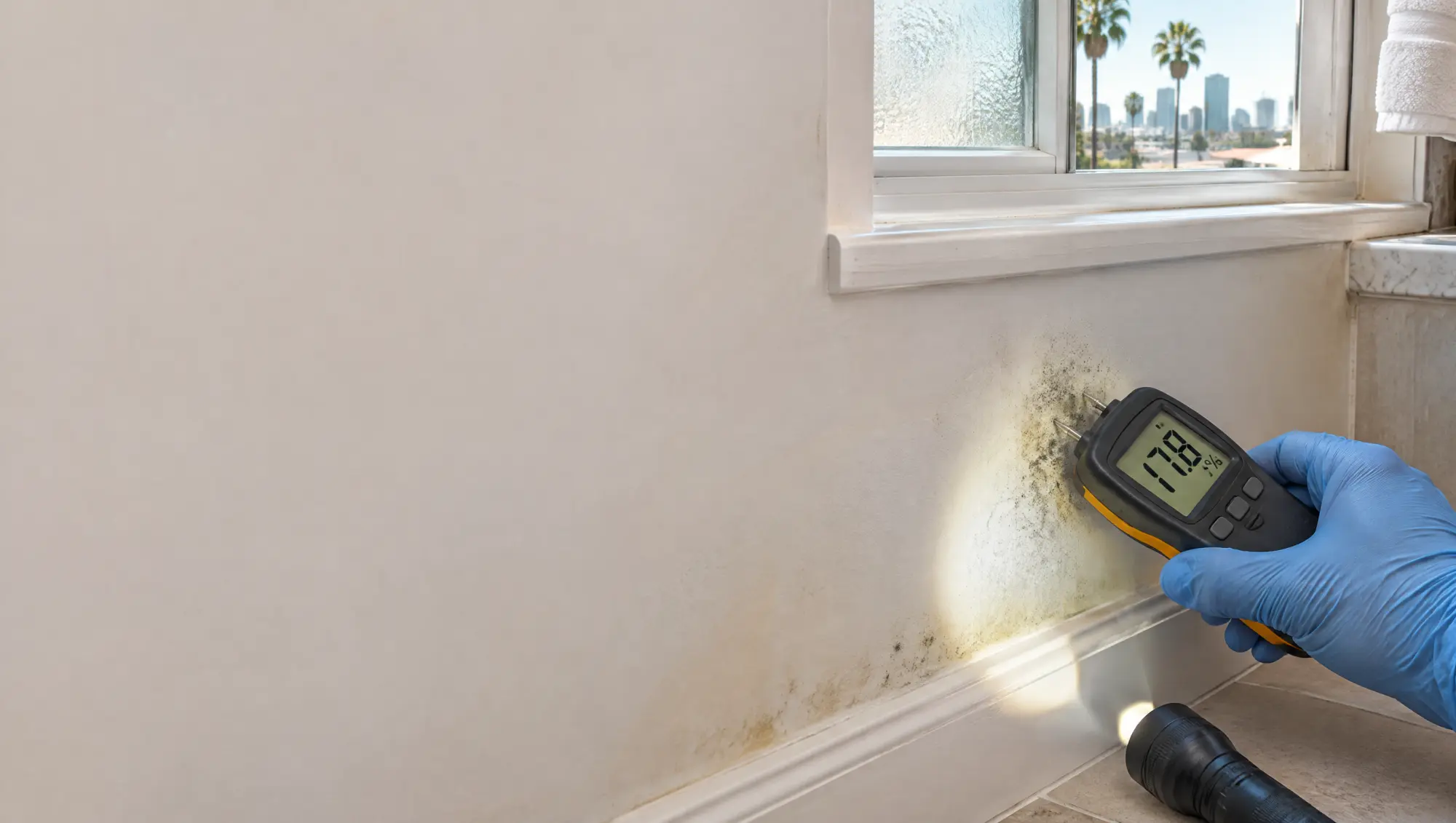
A musty smell that won't go away, dark spots that come back after cleaning, or a line in a home inspection report: you want to know if it's mold, how far it goes and what it takes to fix. Maccraft Restoration's mold inspection is free across San Diego County. We look, measure moisture, find the water that feeds the mold and give you a written scope, with no obligation to hire us. It's part of our mold removal in San Diego.
Key facts
- Free mold inspection, with no obligation
- Moisture meters and a thermal camera to find the water source
- Photos and a written scope with a price range for the work
- We don't lab-test our own work: sampling and clearance are done by an independent tester
- Remediation follows IICRC S520; Maccraft is an IICRC Certified Firm
- Licensed California contractor, CSLB #1137252
Reviewed by Alex Zakharov, Operations Manager. IICRC AMRT, WRT. Updated October 2026.
 Free inspection & written estimate, no obligation
What does a free mold inspection include?
The inspection is a visit to your home by a technician who works on mold jobs, not a sales call. It covers:
- A visual inspection of the area you're worried about and the places mold usually starts nearby: under sinks, behind toilets and the washer, around the water heater, windows and exterior walls, closets on cold walls, the attic and the crawl space.
- Moisture readings with pin and non-invasive meters, and a thermal camera to find wet areas behind drywall and under floors.
- The water source: a leak, condensation, a drain, the roof or humidity. Mold always has one, and removing mold without fixing it doesn't last.
- Photos of everything we find, so you have a record.
- A written scope and price range for the work, if work is needed. If nothing needs doing, we tell you that too.
Is a mold inspection the same as mold testing?
No, and it matters who does which. An inspection answers where is the moisture and how far has the mold spread. Testing means taking air or surface samples and sending them to a lab.
We don't lab-test our own work. When air or surface sampling is useful, or when a clearance test is needed after remediation, it's done by an independent tester, so the result isn't graded by the company that did the work. The EPA notes that when mold is visible, sampling usually isn't needed to decide on removal. Sampling helps when there's a musty smell and nothing to see, when a stain may or may not be mold, or when a buyer, a landlord or the city needs lab results. More in our guide to mold clearance testing.
When should you call for a mold inspection?
- A musty smell in a closet, a bathroom or the whole house, especially when the AC or heater runs
- Spots on drywall, grout, window frames or the ceiling that come back after cleaning
- A leak that went unnoticed for a while: under a sink, behind the dishwasher or from the unit above
- Water damage that was dried by someone without moisture readings
- A tenant complaint about mold (see what landlords should do about a tenant mold complaint)
- A home inspector's report during escrow (see mold inspection before selling)
- Before you cover up an old stain with new paint or flooring
Why does mold keep showing up in San Diego homes?
Coastal neighborhoods get months of marine layer and damp mornings, and closets and bathrooms on the shady side of a house stay cool and humid. Inland, most mold we see starts with plumbing: a supply line under a sink, a dishwasher, a water heater closet or a slab leak. Older homes on raised foundations add the crawl space. In condos and apartments, water from the unit above can sit inside a ceiling for days before anyone sees it. Wherever it is, the fix starts with finding the moisture.
What happens if we find mold?
You get the findings on the spot, then a written scope. If the area is small and on a hard surface, we may tell you it's something you can clean yourself, and how. If it needs remediation, the work follows IICRC S520:
- Fix the source first. A plumber, roofer or HVAC technician repairs the cause; we coordinate the timing.
- Containment with plastic walls and HEPA-filtered negative air, so spores don't spread to the rest of the home.
- Removal of moldy porous materials, then HEPA vacuuming and cleaning of what stays.
- Drying, confirmed with moisture readings.
- Independent clearance testing when it's part of the job, before anything is closed up.
- Repairs by our licensed team: drywall, insulation, cabinets, texture and paint.
See mold removal in San Diego for how a full job runs, or crawl space mold removal if it's under the house.
Does insurance cover mold?
Sometimes. Mold that resulted from a sudden, covered water loss may fall under that claim. Mold from a long-term leak or humidity often isn't covered, and many policies limit mold coverage. Your policy decides, and your adjuster confirms coverage for your claim. The inspection gives you the photos and moisture readings an adjuster asks for. If you pay yourself, you get a written price before any work starts.
Frequently Asked Questions
Still have a question? Call (619) 510-1998
Is the mold inspection really free?
Do you test the air?
How long does a mold inspection take?
Can I stay in the house?
Do you work with landlords and property managers?
Worried about mold?
Call Maccraft Restoration to schedule a free mold inspection.
 Free Mold Inspection
Work With Insurance
 Call (619) 510‑1998