
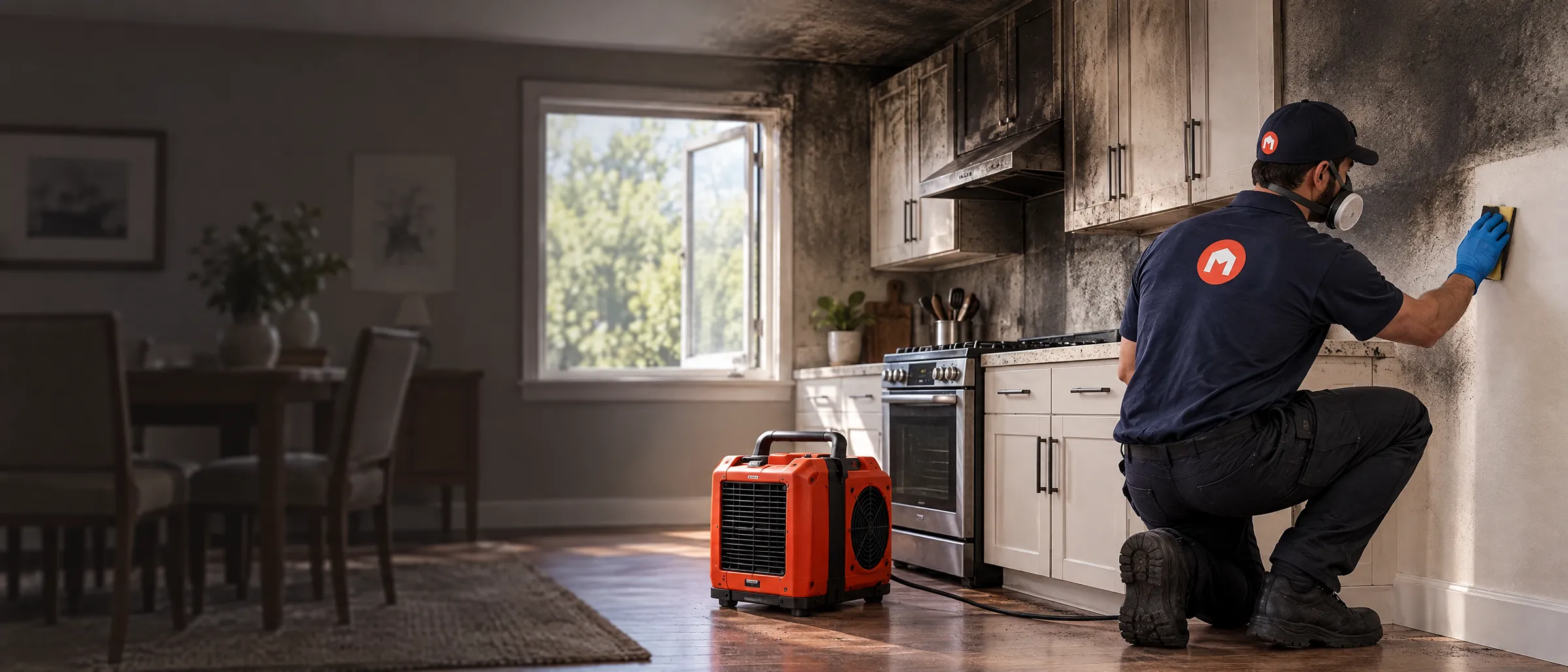
Fire & Smoke Damage Restoration in San Diego
★ 5.0 · 22 Google reviews · 24/7 · free inspection · IICRC Certified Firm · BBB Accredited · CA License #1137252
After a fire, the damage doesn't stop when the flames go out. Soot is acidic and starts etching surfaces within hours, smoke odor works its way into drywall, insulation and HVAC, and the water used to put the fire out brings its own risk of mold. Maccraft Restoration responds 24/7 across San Diego County to secure the property, stop secondary damage, and restore it to pre-loss condition. Our crew handles board-up, soot and smoke cleanup, smoke odor removal and removal of burned materials in-house, and our process follows the ANSI/IICRC S700 standard for fire and smoke damage restoration.
Key facts
- 24/7 emergency response, board-up and roof tarping
- Soot and smoke cleanup, smoke odor removal and demolition of burned materials done by our own crew
- Work led by an IICRC Fire and Smoke Restoration Technician (FSRT) and Odor Control Technician (OCT)
- Big losses and small jobs: house fires on an insurance claim, kitchen fires, smoke odor and wildfire smoke — with or without insurance
- Water from firefighting dried to prevent mold
- Licensed general contractor (CSLB #1137252): cleanup and rebuild coordinated by one team
- We document the loss and work directly with your insurer
Reviewed by Alex Zakharov, Operations Manager. IICRC FSRT, OCT. Updated November 2026.
 Free inspection & written estimate, no obligation
What should you do in the first 24 hours after a house fire?
- Make sure the fire department has cleared the building before you go back in.
- Call your insurance company to open a claim, and photograph every room before anything is moved.
- Don't turn on the HVAC system: it pulls soot through the whole house.
- Don't wipe soot with a wet cloth or household cleaner: it smears into paint and fabric.
- Open windows if the weather allows, and keep children and pets out of affected rooms.
- Call a fire and smoke restoration company to secure openings and stop secondary damage. We answer 24/7 at (619) 510‑1998.
What does fire and smoke damage restoration include?
- Emergency response and board-up — we secure openings, tarp the roof if needed, and document every room with photos for your insurer.
- Water extraction and drying — water from firefighting is removed and the structure is dried to prevent mold.
- Demolition of burned materials — charred drywall, insulation and other materials that can't be cleaned are removed so the smell doesn't come back.
- Soot and smoke cleaning — surfaces are cleaned with methods matched to the type of residue (dry smoke, wet smoke, protein).
- Odor removal — deodorization targets the source, not just the air. More on smoke odor removal.
- Rebuild — as a licensed general contractor, we coordinate drywall, paint and repairs so you deal with one team.
Why does the type of smoke residue matter?
Not all soot is the same, and the wrong cleaning method can smear it deeper into surfaces:
- Dry smoke comes from fast, hot fires burning paper and wood. Its residue is powdery and easier to remove.
- Wet smoke comes from slow, smoldering fires and burning plastics. Its residue is sticky and smears, and it carries a strong odor.
- Protein residue comes from kitchen fires where food burned. It is almost invisible but discolors paint and leaves a heavy smell.
We identify the residue first, then choose dry cleaning sponges, HEPA vacuuming or wet cleaning to match.
Wildfire smoke got into your home — what now?
A house doesn't have to burn to be damaged by a wildfire. Homes near canyons and open space can get fine ash on surfaces, smoke odor in fabrics and drywall, and soot drawn into the attic and HVAC system. Don't sweep or vacuum ash with a household vacuum: it spreads fine particles, and wet ash can be caustic. Many homeowners policies cover smoke damage from a wildfire; your adjuster confirms coverage for your claim.
The IICRC fire and smoke standard (S700) does not cover wildfire smoke, so ask any company how they assess and clean it. We test surfaces room by room and clean the attic, HVAC registers and soft materials where smoke settled.
What can be saved after fire and smoke damage?
Hard, non-porous items such as glass, metal and sealed wood usually clean well. Porous materials (drywall, insulation, carpet, upholstery) depend on how much smoke they absorbed; some can be cleaned and deodorized, others must be replaced. Charred materials are always replaced. We photograph affected rooms and materials so salvage and replacement decisions are documented for your adjuster.
Do you handle small smoke damage jobs without insurance?
Yes. Not every fire is a total loss. A stovetop fire, a burned pot, smoke from a fireplace, a neighbor's fire or a wildfire can leave soot on walls and a smell that won't go away. We clean the residue, remove the source of the odor and give you a written price before we start, so you can decide whether to pay directly or file a claim. The inspection is free.
Fire and smoke damage restoration by city
We cover all of San Diego County. These are the areas we are called to most often — each has its own page with local detail:
Certified & Licensed
Fire Damage Questions
Still have a question? Call (619) 510-1998
Do you work with my insurance?
How long does fire damage restoration take?
Is it safe to stay in the house after a fire?
Can I clean soot myself?
Will the smoke smell ever go away?
Does the HVAC system need cleaning after a fire?
Who should I call for smoke damage?
How much does smoke damage cleanup cost?
Fire or smoke damage? Call (619) 510‑1998 — available 24/7.
 24/7 Board-Up
Work With Insurance
Free Inspection
 Call (619) 510‑1998