
Water Damage Inspection in San Diego
★ 5.0 · 22 Google reviews · 24/7 · free inspection · IICRC Certified Firm · BBB Accredited · CA License #1137252 · On site within an hour for water emergencies
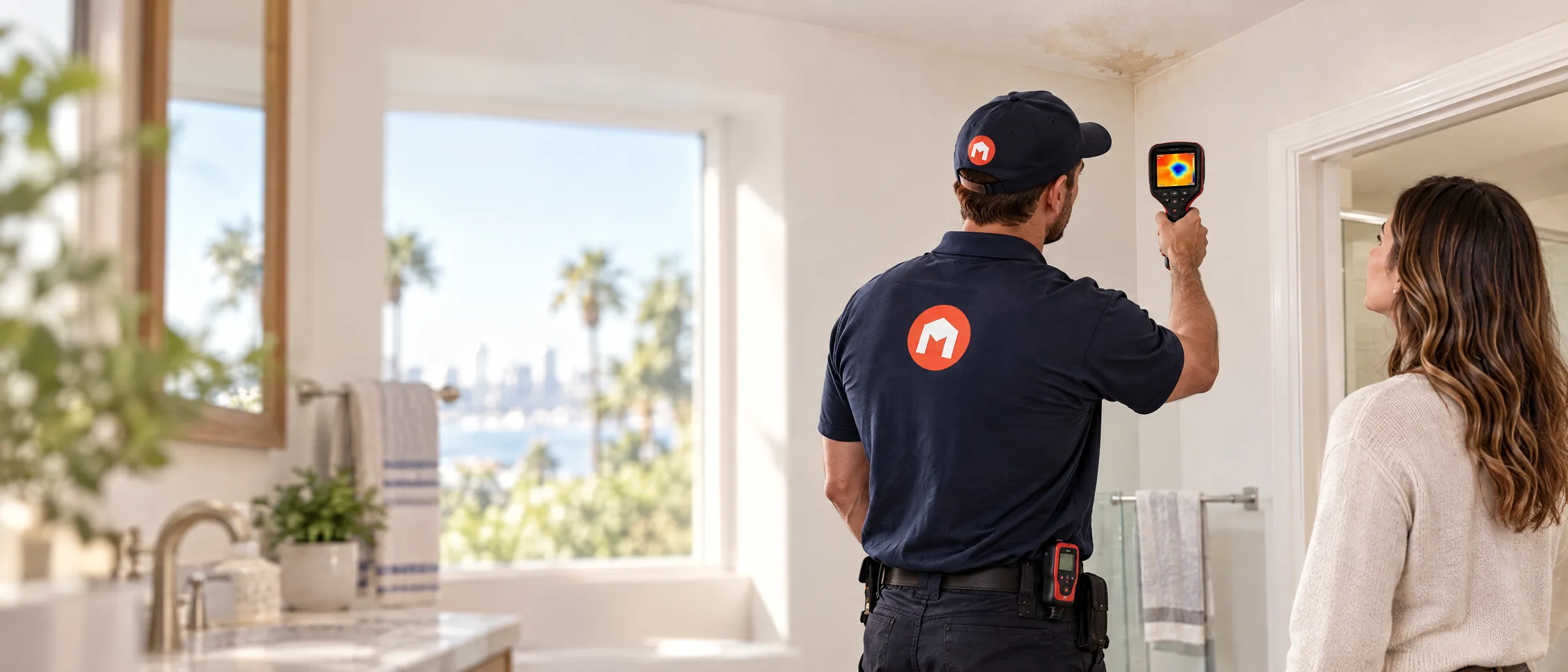
A water damage inspection, or a flood damage inspection after a bigger loss, shows how far water has spread inside your walls, floors and ceilings, and whether it needs professional drying. Maccraft Restoration's inspection is free across San Diego County. We map moisture with meters and a thermal camera, find the source, photograph everything, and tell you plainly what needs to happen next, including when nothing does.
Key facts
- Free, with no obligation to hire us
- Moisture meters, a thermo-hygrometer and a thermal imaging camera
- Photos, readings and a moisture map you can give your insurer
- Done by an IICRC-certified water restoration technician
- If drying is needed in an emergency, we can start on the same visit
- Not a home-sale inspection and not a mold test; we refer independent testers
Reviewed by Alex Zakharov, Operations Manager. IICRC WRT, ASD. Updated November 2026.
 Free inspection & written estimate, no obligation
How do I know if there's water damage behind my walls?
Hidden water damage behind walls rarely shows all at once. These are the usual signs of water damage in drywall, ceilings and floors, and the moments when an inspection with moisture readings is worth it:
- You see a stain, bubbling paint or a soft spot on a ceiling or wall
- Your water bill jumped with no change in use
- A plumber fixed a leak, but you don't know how much got wet
- Water came through from the unit above
- There's a musty smell near a bathroom, kitchen, water heater or AC unit
- Flooring is cupping, lifting or feels soft
- You plan to file an insurance claim and need documentation
What we check
We go room by room around the water source and wherever water could have traveled:
- ceilings below bathrooms and laundry rooms;
- walls behind toilets, sinks, tubs and appliances;
- baseboards and flooring;
- the inside of sink and vanity cabinets;
- the attic after a roof leak;
- the crawl space in homes on a raised foundation.
We look for the source too: supply lines, drains, water heaters, AC condensate lines, roofs and windows.
The tools, and what they tell us
- Pin moisture meter: measures moisture inside drywall and wood at a specific point, to confirm a material is wet.
- Non-invasive moisture meter: scans behind surfaces without making holes, to find the edges of the wet area.
- Thermo-hygrometer: measures air temperature and relative humidity, to show how fast the room can dry and whether condensation is a risk.
- Thermal imaging camera: shows temperature differences, so wet areas often appear cooler. It points to where to measure; a meter confirms it.
What you get after the inspection
- Our findings explained on site, in plain language
- Photos and moisture readings for every affected area
- A moisture map showing where the wet area starts and ends
- A clear recommendation: dry in place, remove and dry, or no work needed
- If work is needed, an itemized estimate
- Documentation in the form adjusters expect, if you file a claim
Do I need an inspection before filing a claim?
You don't need one to open a claim, but it helps. Adjusters ask for photos, moisture readings and a clear picture of how far the water went, and water inside a wall or under a floor doesn't show in a photo. The free inspection gives you that documentation, and once the claim is open we can talk to your adjuster. Your adjuster confirms coverage for your claim.
Water damage inspection vs. leak detection vs. mold testing
These are three different jobs, and it helps to know who does what:
- A plumber's leak detection finds and repairs the broken pipe or fitting.
- A water damage inspection finds where the water went after it escaped, and whether walls, floors and cabinets need drying.
- Mold testing is done by an independent lab or inspector, before or after remediation.
Fixing the pipe doesn't dry the wall, so after a leak you usually need the first two.
After the inspection
If everything reads dry, you're done, and you have the readings on record. If materials are wet, we explain the options and the timeline, and with your OK, drying can start right away: see water damage restoration. If we find mold, see mold remediation.
Water damage inspection by city
We cover all of San Diego County. These are the areas we are called to most often — each has its own page with local detail:
Certified & Licensed
Water damage inspection questions
Still have a question? Call (619) 510-1998
Is the inspection really free?
Can you find water behind a wall without opening it?
My plumber already fixed the leak. Do I still need an inspection?
Will your inspection help my insurance claim?
Do you also test for mold?
Before we arrive: what to do in the first 24 hours after a leak.
Not sure how far the water went? Book a free inspection.
 Arrive Within 1 Hour
Work With Insurance
Free Inspection
 Call (619) 510‑1998