
Mold Remediation in San Diego
★ 5.0 · 22 Google reviews · Free mold inspection · IICRC Certified Firm · BBB Accredited · CA License #1137252
Maccraft Restoration removes mold from homes and businesses across San Diego County following the IICRC S520 standard. We find and stop the moisture that feeds the mold, remove contaminated materials under containment with HEPA air filtration, and leave clearance testing to an independent lab, so the result isn't graded by the company that did the work. The mold inspection is free. For a home in the city, see mold removal in San Diego.
Key facts
- Remediation follows IICRC S520; Maccraft is an IICRC Certified Firm
- Work led by an IICRC Applied Microbial Remediation Technician (AMRT)
- Containment with negative air pressure and HEPA air scrubbers
- Independent third-party clearance testing; we never test our own work
- The moisture source is found and fixed first, so mold doesn't come back
- Licensed general contractor (CSLB #1137252): we rebuild after the area passes
Reviewed by Alex Zakharov, Operations Manager. IICRC AMRT, WRT. Updated November 2026.
 Free inspection & written estimate, no obligation
Signs of hidden mold
- A musty smell that comes back after cleaning
- Stains, peeling paint or bubbling at the base of walls or on ceilings
- Swollen baseboards or soft drywall near a bathroom, kitchen or water heater
- A past leak that was never professionally dried
- Condensation on windows and walls, common in coastal homes during marine-layer months
- An air test showing elevated spore counts
Mold remediation vs. mold removal
Mold spores are present in all indoor and outdoor air, so no company can remove every spore from a home, and anyone who promises that is overselling. The IICRC S520 standard defines the goal of remediation as returning the affected area to normal fungal ecology. That is the level you would find in a comparable clean building, not zero.
In practice that means removing growth, cleaning the settled spores around it and fixing the moisture problem behind it. S520 describes three conditions:
- Condition 1: normal fungal ecology.
- Condition 2: settled spores from a nearby source.
- Condition 3: actual mold growth.
Remediation brings Condition 2 and 3 areas back to Condition 1.
How our mold remediation process works
- Assessment and moisture source. We map moisture with meters and a thermal camera and find what is feeding the mold: a slow drain leak, a supply line, a roof or window leak, AC condensate or trapped humidity. If you already have a mold inspection or air test report, we work from it.
- Fix the source. Your plumber or roofer repairs the cause before we remove anything. Otherwise the mold returns. We can recommend one.
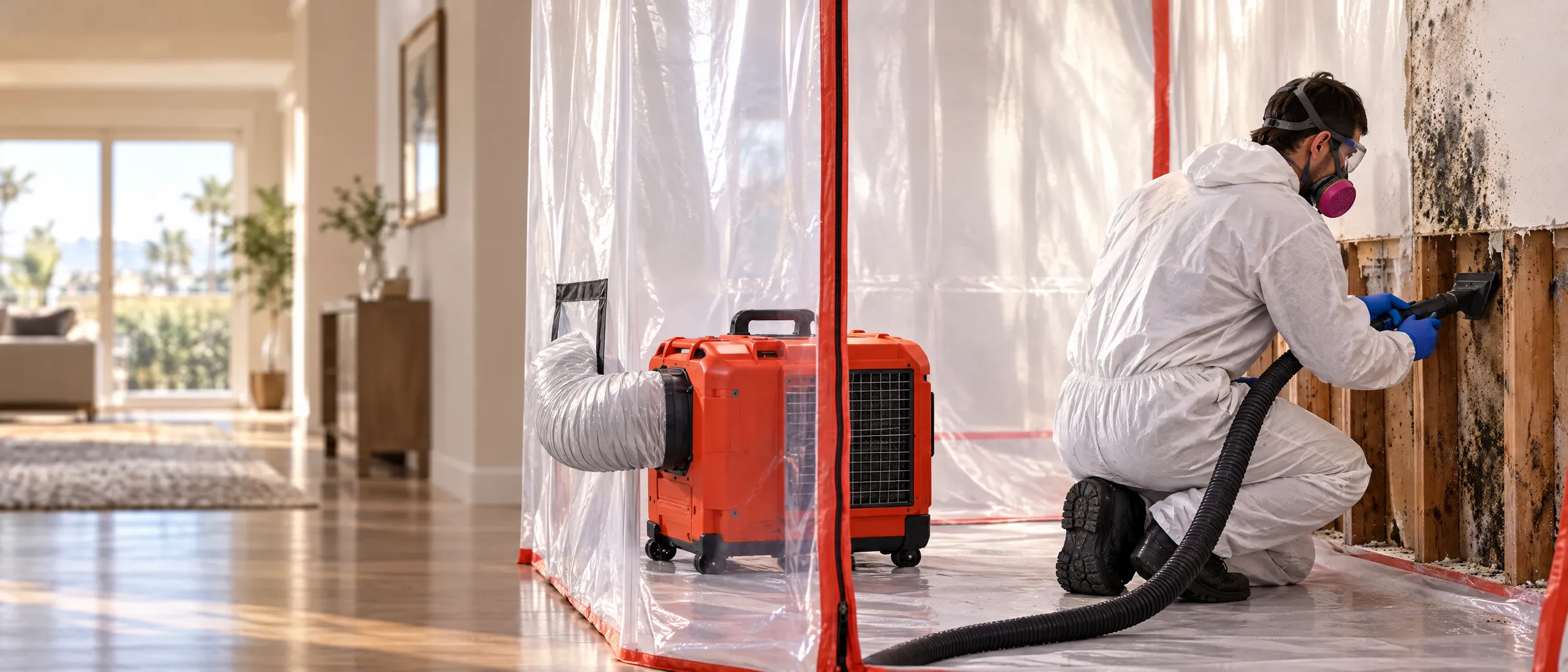
- Containment. Plastic barriers and a zipper door seal the work area. HEPA air scrubbers keep it under negative pressure, so spores flow into the filters instead of into the rest of the house.
- Removal and cleaning. Porous materials with growth (drywall, insulation, carpet pad, particleboard cabinets) are removed, bagged and taken out. Framing and hard surfaces are HEPA-vacuumed and cleaned, and sanded where growth has stained the wood.
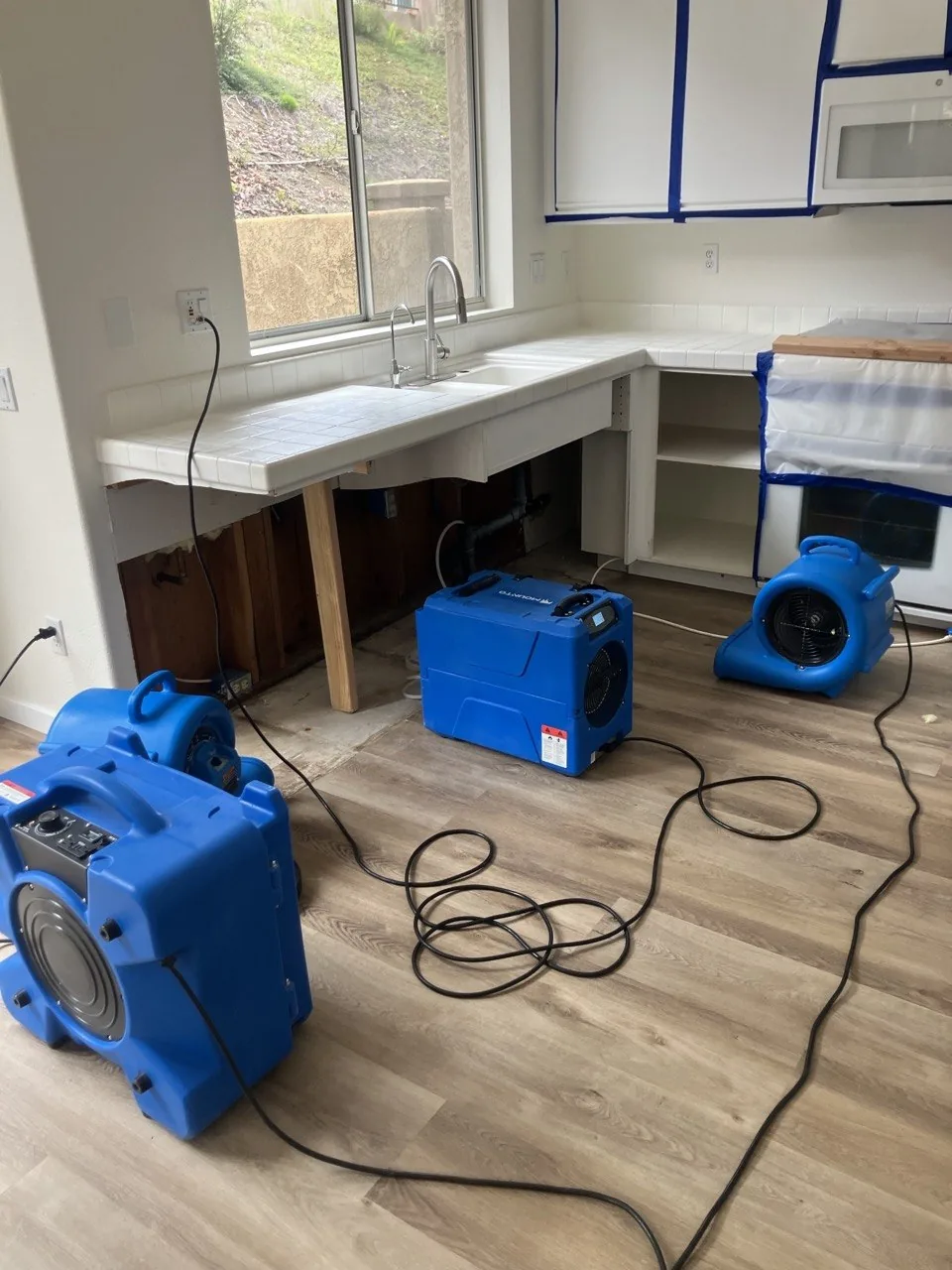
- Drying and treatment. Remaining materials are dried to normal moisture levels. Antimicrobial treatment is applied where appropriate, after cleaning, never instead of it.
- Independent clearance testing. A third-party lab tests the area. If spore counts are still elevated, we clean again and the lab re-tests.
- Rebuild. New drywall, insulation and cabinets go in only after the area passes.
Why we don't test our own work
A remediation company that also tests its own job has a reason to pass it. We use an independent third party for clearance testing, so the result is unbiased and you, your buyer or your insurer can rely on it. More in Mold Clearance Testing in San Diego: What to Expect.
How long does mold remediation take?
Removal and cleaning in a single room often takes 1 to 3 days. Several rooms, attics or crawl spaces take longer. After that, the area is clearance-tested and the lab needs a few days for results. If the first test fails, add another cleaning and re-test. The rebuild starts after a passing result.
Mold remediation cost and insurance
The cost depends on how large the affected area is, where it is (an open wall, behind cabinets, in an attic or a crawl space), which materials must be removed, and how much containment the job needs. Clearance testing is billed by the testing company. After the free inspection you get an itemized estimate.
Many California homeowners policies cover mold only when it results from a covered, sudden water loss, often with a dollar limit. Mold from a long-term leak or ongoing humidity is usually excluded. Your adjuster confirms coverage. When it's covered, we bill the insurer directly.
When you can clean mold yourself, and when you shouldn't
The EPA's guidance is that homeowners can usually handle a moldy area smaller than about 10 square feet (roughly 3 ft by 3 ft) on a hard surface, using detergent and water, gloves and an N95 mask. Call a professional when:
- the area is larger than that;
- mold is on or inside drywall, insulation or cabinets;
- it came from contaminated water;
- you smell mold but can't see it;
- someone in the home has asthma, allergies or a weakened immune system.
Painting over mold or spraying it without removing it doesn't solve the problem.
Why mold grows in San Diego homes
Our mild climate doesn't cause mold on its own. Hidden water does. The most common sources we find:
- slow leaks under kitchen and bathroom sinks;
- water heaters in garages and closets;
- AC condensate lines dripping inside walls;
- roof and window leaks after winter storms;
- bathrooms without a working exhaust fan.
In beach communities like Pacific Beach, Point Loma and Coronado, the marine layer adds humidity that keeps damp areas from drying. Older homes on raised foundations can trap moisture under the floor. See crawl space mold removal.
Looking for your area? See mold removal across San Diego neighborhoods.
Recent mold remediation projects
Mold remediation by city
We cover all of San Diego County. Every area below has its own page with local detail:
Certified & Licensed
Mold remediation questions
Still have a question? Call (619) 510-1998
Is it safe to stay home during mold remediation?
Will the mold come back after remediation?
Do I need a mold test before remediation?
Can mold be painted over or sealed?
Is black mold more dangerous than other mold?
Does California license mold remediation companies?
Found mold? Call (619) 510‑1998 for a free inspection.
 Free Mold Inspection
Work With Insurance
 Call (619) 510‑1998