
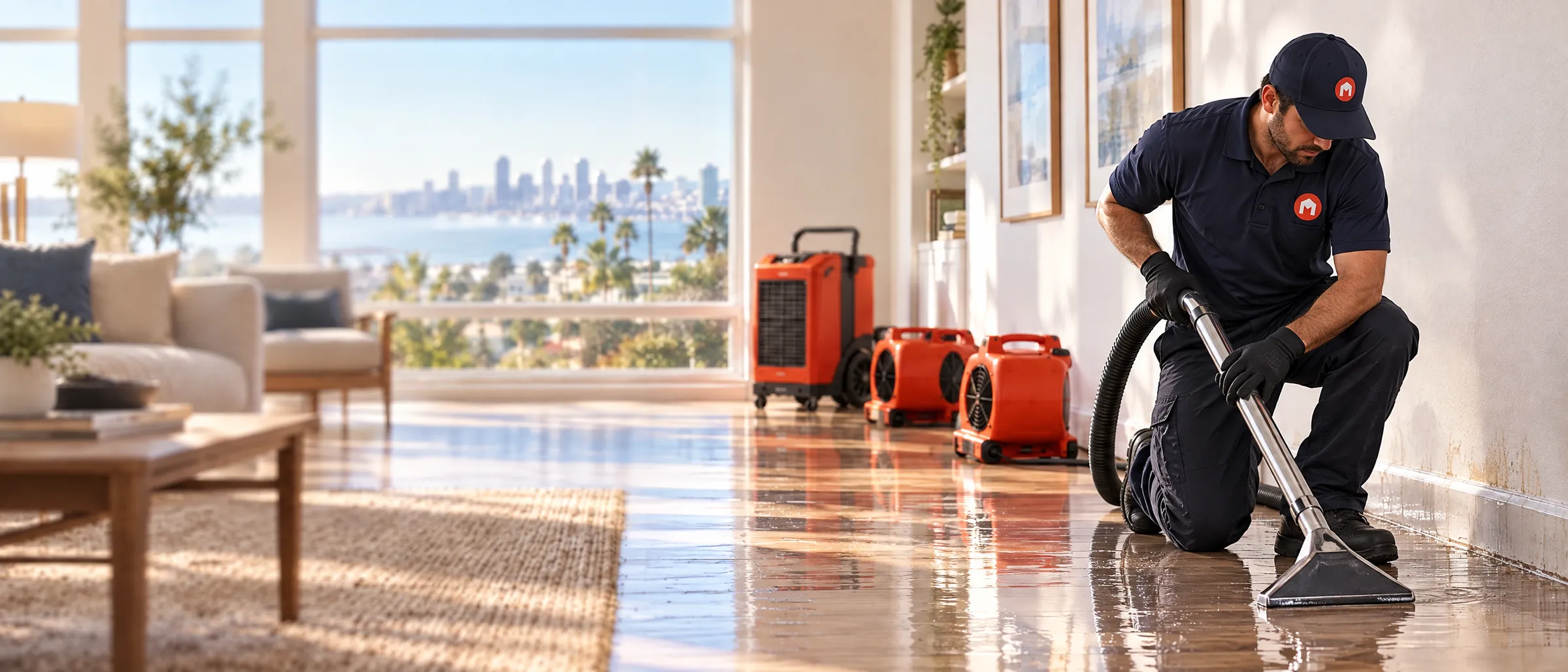
Water Damage Restoration in San Diego
★ 5.0 · 22 Google reviews · 24/7 · free inspection · IICRC Certified Firm · BBB Accredited · CA License #1137252 · On site within an hour for water emergencies
Maccraft Restoration provides 24/7 water damage restoration and water damage repair across San Diego County. We stop the water, handle emergency water removal and extraction, and dry the structure to the IICRC S500 standard, with daily moisture readings and the documentation your insurance claim needs. On site within an hour for water emergencies anywhere in our San Diego County service area, about 20 minutes in central San Diego, and the inspection is free.
Key facts
- Available 24/7, including weekends and holidays
- On site within an hour for water emergencies anywhere in our San Diego County service area
- Drying follows IICRC S500; Maccraft is an IICRC Certified Firm
- Field work is led by an IICRC-certified Water Restoration Technician and Applied Structural Drying technician
- Direct insurance billing: you pay your deductible and anything the policy doesn't cover
- Licensed California general contractor (CSLB #1137252), so the same team can do the repairs
Reviewed by Alex Zakharov, Operations Manager. IICRC WRT, ASD. Updated November 2026.
 Free inspection & written estimate, no obligation
What should you do in the first 24 hours after water damage?
- Shut off the water at the fixture, or at the main valve if you can't find the source.
- If water is near outlets, light fixtures or appliances, turn off power to that area at the breaker panel, but only if you can reach it without standing in water.
- Stay out from under a ceiling that is sagging or dripping.
- Move rugs, electronics and furniture off wet floors.
- Take photos and video of the source and every wet area before anything is thrown away. Your insurer will want them.
- Call us. You don't need to wait for the adjuster before drying starts: most policies expect you to prevent further damage.
The full checklist: what to do in the first 24 hours after a water leak.
Water damage categories and classes (IICRC S500)
Two labels from the IICRC S500 standard decide how a water damage cleanup is done. The category says how clean the water is. The class says how much water there is to evaporate, which drives the equipment and the drying time.
- Category 1, clean water: from a broken supply line, a faucet or a water heater. Materials that are still sound can often be dried in place.
- Category 2, gray water: from a dishwasher, a washing machine or a toilet overflow without waste. It carries contaminants, so carpet pad and other porous materials it soaked usually come out.
- Category 3, black water: sewage, a toilet overflow with waste, or floodwater from outside. Porous materials it touched are removed, and the area is cleaned and disinfected.
- Class 1: a small area, little water absorbed. The easiest to dry.
- Class 2: a whole room, with water wicked up the walls and into carpet and pad.
- Class 3: the most water: often from above, soaking ceilings, insulation, walls and floors.
- Class 4: dense materials that hold water, such as hardwood, plaster, concrete or a slab. They need longer drying, often with special equipment.
Water also gets worse with time: clean water that sits for a day or two in a warm house can turn into Category 2. That is one more reason to start the flood damage restoration the same day.
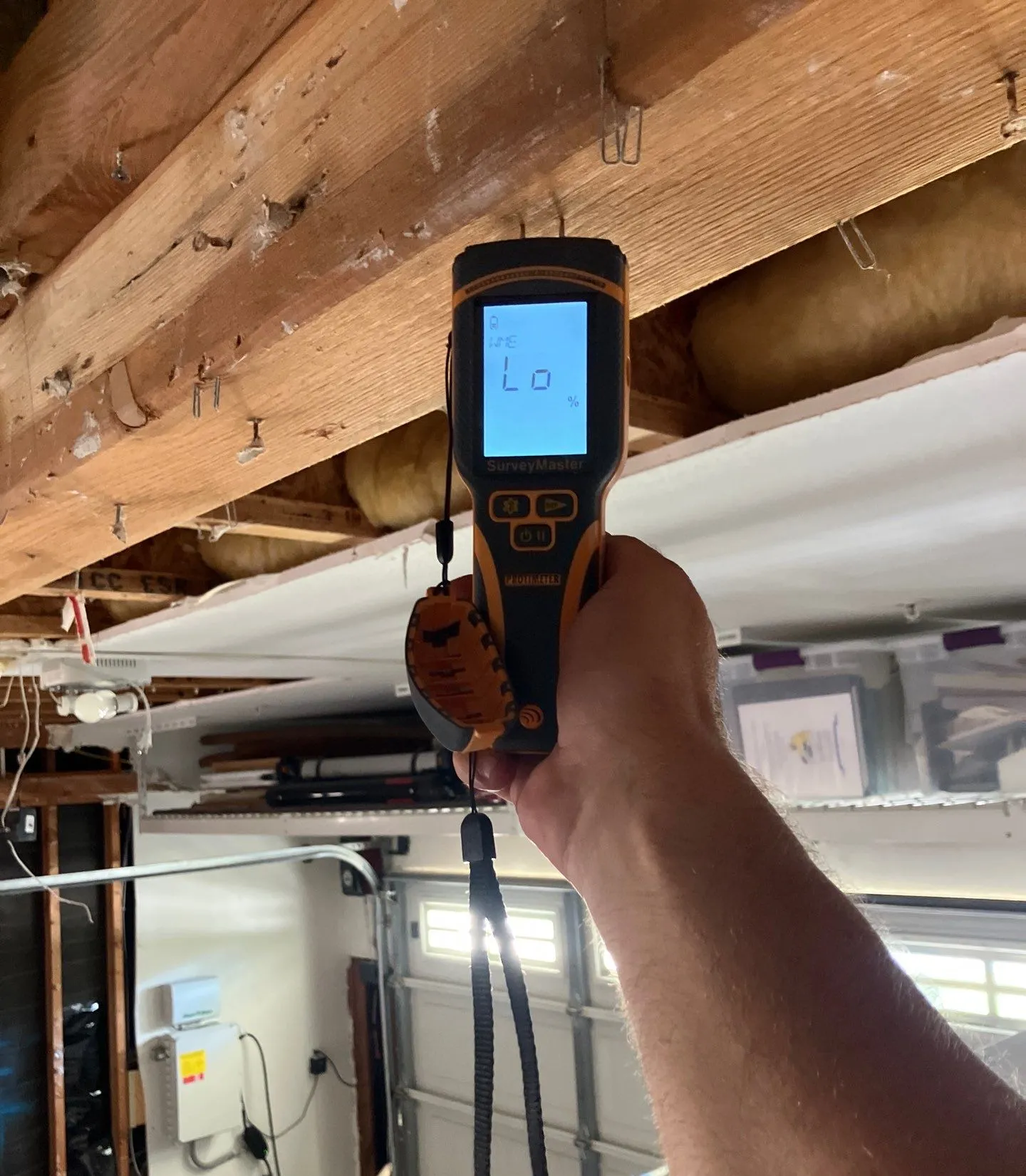
How our water damage restoration process works
- Inspection and moisture mapping. We trace where the water went with moisture meters and a thermal camera: under flooring, behind baseboards, inside walls and ceilings. We also identify the water category: clean water from a supply line (Category 1), gray water from appliances or drains (Category 2), or black water such as sewage or outside floodwater (Category 3). The category decides what can be dried in place and what has to be removed.
- Extraction. Once the source is stopped, we remove standing water with pumps and extractors. Pulling water out in liquid form is far faster than evaporating it later.
- Removing only what can't be dried. Wet insulation, swollen baseboards, carpet pad and saturated drywall are cut out. Drywall that is wet but sound, from clean water, can often be dried in place.
- Structural drying. Air movers and dehumidifiers are sized to the affected area. Containment keeps the drying zone small and the rest of the home usable.
- Daily monitoring. We take readings at every visit, log them, and adjust equipment as materials dry.
- Dry standard and handover. The job is dry when readings in affected materials match the same materials in an unaffected part of the home. Then the equipment comes out, the adjuster gets the full documentation package, and we give you a repair estimate.
What's included
- Emergency response and water extraction
- Moisture mapping, thermal imaging and photo documentation
- Removal and disposal of wet materials that can't be saved
- Structural drying with daily moisture logs
- Antimicrobial treatment where the water category calls for it
- Moving and protecting contents in the affected rooms
- Lead-safe work practices (EPA RRP) in homes built before 1978
- Repairs by the same licensed team: see reconstruction and repairs
How long does it take to dry out after water damage?
Most residential drying jobs take 3 to 5 days once equipment is in place. A small leak caught early can dry sooner. When water reaches ceilings, insulation or more than one unit, drying with daily monitoring can take one to two weeks. Hardwood floors, plaster and other dense materials dry more slowly than drywall. Repairs start once readings confirm the structure is dry.
The biggest delay is usually a late start. The EPA notes that mold can begin to grow on wet materials within 24 to 48 hours, so drying should start the same day if possible.
What water damage restoration costs in San Diego
Every water damage job is priced on what actually got wet, so there is no honest flat number. The cost depends on:
- The size of the wet area: one closet or the whole first floor, and whether it reached a ceiling or a unit below
- The water category: clean water from a supply line costs less to clean up than gray or black water
- The materials: drywall, insulation, carpet and pad, hardwood, plaster or a concrete slab all dry differently
- Demolition: how much has to be cut out and taken away because it can't be dried
- Days of drying: how many days the air movers and dehumidifiers run, with a moisture check at every visit
The inspection is free and so is the written estimate. On an insurance claim we bill your insurer directly, and you usually pay only your deductible and anything the policy doesn't cover. If you pay yourself, you get a written price before any work starts.
Does homeowners insurance cover water damage?
California homeowners policies usually cover sudden and accidental water damage, such as a burst supply line or a failed water heater. They usually do not cover long-term leaks, flooding from outside (that needs flood insurance) or maintenance problems. Your adjuster confirms coverage for your claim. More detail in Does Homeowners Insurance Cover Water Damage in California?
Water came from the condo above? Read Leak From the Condo Above: Who Pays?
Common causes we see in San Diego homes
- Water through the ceilingWater coming through your ceiling?
- Dishwasher leakDishwasher leaked and everything is wet?
- Washing machine leakWasher hose or connector failed?
- Toilet overflow or leakToilet overflowed or leaking at the base?
- Pipe leak in a wallStains, bubbling paint or a high water bill?
- Water heater leakWater heater leaking into the garage, a closet or under the floor?
- Failed supply lines to toilets, sinks and refrigerators: see toilet leaks and leaking pipes in the wall
- Water heaters leaking in garages, closets and attics, see water heater leaks
- Washing machines: burst hoses and overflows, see washing machine leaks
- Dishwashers leaking under the cabinets, see dishwasher leaks
- Slab leaks and pinhole leaks in aging copper pipes, see leaking pipes in the wall
- Condo leaks from above coming through the ceiling, see water leaking from the ceiling
We don't repair the plumbing itself: a plumber fixes the source, and we handle the water damage cleanup, drying and repairs. Commercial property? See commercial water damage restoration →
Water damage restoration by city
We cover all of San Diego County. These are the areas we are called to most often — each has its own page with local detail:
Certified & Licensed
Water damage questions
Still have a question? Call (619) 510-1998
What's the difference between water mitigation and water damage restoration?
Will my drywall have to be removed?
Should I call my insurance company before calling you?
How do you know the house is really dry?
Do you handle sewage backups?
Can water damage cause mold?
More answers: what to do in the first 24 hours after a leak · how long drying takes
Water damage right now? Call (619) 510‑1998, 24/7.
 Arrive Within 1 Hour
Work With Insurance
Free Inspection
 Call (619) 510‑1998