
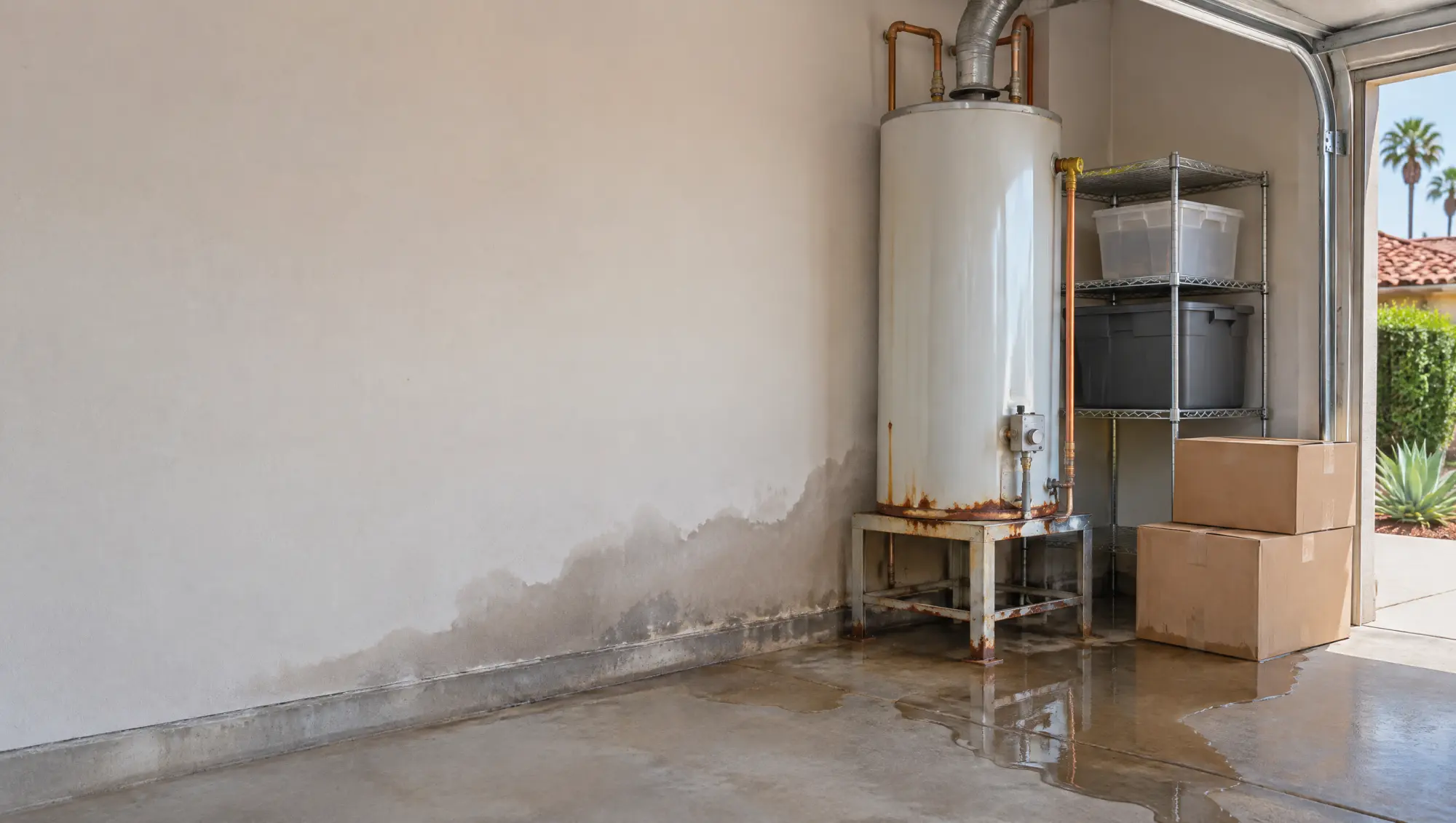
Water Heater Leaking? Water Damage Cleanup in San Diego
★ 5.0 · 21 Google reviews · IICRC Certified Firm · BBB Accredited · CA License #1137252 · On site within an hour for water emergencies
A water heater tank holds a lot of water, and when the tank or a fitting fails, all of it goes somewhere: across the garage slab, into the drywall, under the flooring of the closet next to it. A plumber repairs or replaces the heater. We handle the water damage cleanup: we find where the water went, dry it to IICRC S500, prevent mold and repair what has to be replaced. Call us 24/7. The inspection is free. It's part of our water damage restoration.
Key facts
- Available 24/7, including weekends and holidays
- On site within an hour for water emergencies anywhere in our San Diego County service area
- IICRC Certified Firm, with drying done to the IICRC S500 standard
- We bill your insurance directly, and you pay the deductible and anything not covered
- Licensed California contractor, CSLB #1137252
Reviewed by Alex Zakharov, Operations Manager. IICRC WRT, ASD. Updated October 2026.
 Free inspection & written estimate, no obligation
What should I do right now?
- Shut off the cold water supply to the heater. The valve is on the cold line at the top of the tank. If you can't find it or it won't turn, close the main water valve to the house.
- Turn off the gas or the power. On a gas heater, turn the control knob to Off or Pilot. On an electric heater, switch off its breaker.
- Don't touch wet electrical. If water is near outlets, a panel or an extension cord, stay out of the water and leave the breaker to someone who can reach it dry.
- Move things off the wet floor: boxes in the garage, rugs, anything stored in the closet.
- Take photos of the heater, the leak and every wet area, then call a plumber and call us. Drying should start the same day.
Where does the water from a water heater go?
Further than the puddle shows. Water heaters sit in garages, closets, laundry rooms and sometimes attics, and each spreads water differently:
- Garage slab: water runs across the concrete and wicks into the bottom of the drywall and the baseboards on the shared wall with the house.
- Drywall bottoms: walls next to the heater soak up water from the bottom, often a foot or more above the floor.
- Closets next to the heater: water runs under the wall plate into the hallway, a bedroom closet or the laundry.
- Under the flooring: carpet pad, laminate and hardwood next to the heater closet hold water long after the surface feels dry.
- The ceiling below: a heater in an attic or on a second floor leaks into the rooms underneath.
We trace it with moisture meters and a thermal camera before anything is removed.
Who do I call first: plumber or restoration company?
Both, the same day. A plumber repairs or replaces the water heater: the tank, the valves, the connections and the venting are the plumber's work, and we don't do plumbing. We handle everything the water touched: extraction, removing what can't be dried, drying, mold prevention and repairs.
When the heater is in the way of the repair, we can disconnect it and reconnect it around the demolition, as we do on real jobs, but the heater itself stays the plumber's job. On our Mission Hills job, a licensed plumber replaced the water heater while we dried and rebuilt the house.
How we fix it
- Inspection and moisture mapping around the heater and wherever the water traveled.
- Extraction of standing water from the slab, carpet and floors.
- We remove only what can't be dried: the bottom of wet drywall, swollen baseboards, soaked carpet pad.
- Drying to IICRC S500, with readings at every visit until the materials match the dry standard.
- Mold check before anything is closed up.
- Repairs. As a licensed contractor, we handle the drywall, texture, paint and trim. If flooring needs replacing, we coordinate it with an installer.
Signs of a slow water heater leak
Not every water heater fails all at once. These signs mean water is escaping slowly:
- Rust or corrosion at the base of the tank or on the fittings
- Water or a damp ring on the floor at the bottom of the heater
- Damp, stained or soft drywall on the wall behind the heater
- A musty smell in the garage or the closet
- Swollen baseboards or flooring next to the heater closet
A slow leak is still worth an inspection: the damage is usually behind the wall, not in front of it.
Does insurance cover a water heater leak?
Often the damage is covered and the heater isn't. Many California homeowners policies cover sudden water damage from a failed tank or fitting: the wet drywall, floors and cabinets. The water heater itself is usually treated as wear and tear and not covered. A leak that went on for a long time may be treated as gradual damage. Your adjuster confirms coverage for your claim. We document the loss and bill the claim directly. Read more: Does homeowners insurance cover water damage in California?
Can a water heater leak cause mold?
Yes. The closet or garage corner around a water heater is warm, dark and often poorly ventilated, which is exactly where wet drywall grows mold. The EPA notes that mold can start on wet materials within 24 to 48 hours. Prompt drying, with readings, is the prevention. If the leak was slow and you smell mold, see mold removal in San Diego.
Frequently Asked Questions
Still have a question? Call (619) 510-1998
Is water heater leak damage covered by insurance?
Will my floors need to come out?
How long does drying take after a water heater leak?
Do you replace water heaters?
Water heater leaking right now?
Call Maccraft Restoration 24/7 for a free inspection. For water emergencies we're on site within an hour.
 Arrive Within 1 Hour
Work With Insurance
Free Inspection
 Call (619) 510‑1998